
AI Trends in 2026 Transforming Business Right Now
AI Trends in 2026 Transforming Business Right Now
Artificial intelligence is entering a new phase in 2026. Businesses are moving beyond using AI simply to generate content or answer questions. AI agents are increasingly being given access to company data, software tools, and workflows so they can complete real business tasks.
From autonomous AI agents and agentic payments to enterprise AI governance and AI security, the latest developments show that AI is becoming an operational technology not just an assistant.
For businesses considering AI adoption, understanding these changes is essential for deciding where AI can create value, how to implement it safely, and which technologies are worth investing in.
What Are the Biggest AI Trends in 2026?
The most important AI developments in 2026 include:
- AI agents are moving from assistance to execution
- Businesses are adopting multi-step agentic workflows
- AI agents are entering commerce and payments
- AI security and governance are becoming critical
- Enterprise AI platforms are connecting agents to business systems
- AI regulation is becoming more practical and enforceable
- Companies are focusing more on measurable AI business value
Let’s explore each trend.
1. AI Agents Are Moving From Assistance to Execution
One of the biggest changes in 2026 is the transition from asking AI to do something to delegating work to AI.
Traditional generative AI might help an employee write an email, summarize a document, or brainstorm ideas.
An AI agent can go further by:
- Understanding a business objective
- Searching company information
- Using connected applications
- Making decisions within defined rules
- Executing tasks
- Checking the results
- Escalating issues to humans
OpenAI’s August 2026 enterprise research describes this shift as a move from assistance to delegation, with agents increasingly being used for complex knowledge work across organizations.
For example, instead of asking an AI system to summarize sales leads, a company could deploy an agent that researches leads, qualifies them, updates the CRM, and prepares follow-up actions.
Why this matters
This makes Agentic AI Automation one of the most important opportunities for businesses in 2026.
2. AI Agents Are Taking Over Complete Workflows
AI agents are no longer limited to individual tasks.
Modern enterprise agent systems can coordinate multiple steps across different applications. OpenAI’s current enterprise agent offerings, for example, describe agents that can work across tools, update records, send messages, run scheduled workflows, and operate with approval checkpoints.
A sales workflow could look like:
New lead → Research → Qualification → CRM update → Personalized outreach → Meeting scheduling → Sales notification
Instead of automating each step independently, an AI agent can coordinate the entire workflow.
This creates opportunities for businesses to automate processes across:
- Sales
- Customer service
- Marketing
- Finance
- HR
- IT
- Operations
- Research
- Software development
3. AI Agents Are Entering Payments and Commerce
One of the most notable developments happening right now is the emergence of agentic commerce.
On September 1, 2026, Reuters reported that India is preparing a framework allowing AI agents to execute certain small-value transactions through UPI without requiring user approval for every individual transaction. The proposed framework includes spending limits, identity verification, audit trails, and other safeguards.
This is important because it demonstrates a significant evolution:
AI can potentially move from recommending a purchase to actually completing it.
For example, an agent could eventually:
- Understand what a customer needs
- Search available products
- Compare options
- Select an approved option
- Complete a transaction
- Record the purchase
This emerging model is commonly described as agentic commerce.
It also introduces new questions around authentication, permissions, fraud prevention, liability, and consumer protection.
4. AI Agent Security Is Becoming Essential
More capable agents create more capable risks.
When an AI system can access a CRM, email account, database, payment system, or internal application, a mistake can have real consequences.
Recent reporting has highlighted concerns around autonomous agents behaving unexpectedly, including cases involving agents operating outside controlled environments. Cyber insurers are already examining how traditional policies should address AI-driven incidents.
Businesses deploying AI agents should therefore consider:
- Role-based access
- Least-privilege permissions
- Authentication
- Data encryption
- Audit logs
- Activity monitoring
- Approval checkpoints
- Spending limits
- Emergency shutdown mechanisms
- Human oversight
The smarter an AI agent becomes, the more important its boundaries become.
5. Enterprise AI Is Becoming More Connected
Another major 2026 development is the movement toward AI systems that can operate with the same information and tools employees already use.
Enterprise AI platforms are increasingly designed to connect agents with:
- CRM systems
- Databases
- Internal applications
- Data warehouses
- Communication platforms
- Documents
- Business workflows
OpenAI’s Frontier platform, for example, emphasizes connecting enterprise systems and data so agents can operate across real business environments while maintaining permissions, auditing, and governance.
This means the future of enterprise AI isn’t simply about having a powerful model.
It is about building an AI system around the model.
That system includes data, integrations, tools, security, workflows, evaluations, and monitoring.
6. AI Governance Is Becoming a Business Requirement
As AI becomes more deeply integrated into business operations, governance is becoming increasingly important.
The EU AI Act is one example. Its Article 50 transparency obligations began applying on August 2, 2026, covering specific transparency requirements for providers and deployers of AI systems.
Businesses increasingly need to consider:
- What an AI system is allowed to do
- What information it can access
- When humans must intervene
- How AI-generated content is identified
- How decisions are documented
- How AI activity is monitored
Governance should therefore be considered during AI development—not added after deployment.
7. Businesses Are Focusing on AI ROI
The AI conversation is also changing from:
“Can AI do this?”
to:
“Does AI create enough value to justify implementing it?”
That means businesses should measure AI projects using practical metrics such as:
- Hours saved
- Operating costs reduced
- Customer response time
- Lead conversion
- Revenue generated
- Error reduction
- Employee productivity
- Customer satisfaction
OpenAI’s 2026 enterprise research highlights that organizations further along in AI adoption are increasingly using agents for complex tasks rather than limiting AI to basic assistance.
The companies that benefit most may not necessarily be those using the most AI.
They may be the companies using AI where it produces measurable business outcomes.
What Do These AI Trends Mean for Businesses?
The biggest lesson from 2026 is simple:
AI is moving from a tool employees use to a system that can perform work on their behalf.
Businesses should begin by identifying processes that are:
- Repetitive
- Time-consuming
- Data-driven
- Multi-step
- Dependent on multiple applications
- Easy to measure
Potential opportunities include:
Sales
AI agents can research prospects, qualify leads, update CRMs, and coordinate follow-ups.
Customer Support
Agents can classify requests, retrieve information, resolve common issues, and escalate complex cases.
Finance
AI can assist with invoice processing, document analysis, reporting, and financial workflows.
HR
Agents can help with candidate screening, scheduling, employee questions, and recruitment workflows.
IT
AI agents can troubleshoot common issues, analyze tickets, and coordinate technical workflows.
Operations
Agents can connect information across systems and automate repetitive operational processes.
How Businesses Can Prepare for AI in 2026
Companies don’t need to automate their entire organization immediately.
A better approach is to:
1. Identify one valuable workflow.
Choose a process where automation could produce measurable results.
2. Define the AI agent’s responsibilities.
Specify what it can and cannot do.
3. Connect the required data and tools.
Give the agent access only to the systems it needs.
4. Build security and approval controls.
Use human oversight for sensitive actions.
5. Test with real-world scenarios.
Measure accuracy, reliability, cost, and completion rates.
6. Expand gradually.
Move from recommendations to approved actions and eventually to controlled autonomy.
The Future of AI Is Agentic
The biggest AI story of 2026 isn’t simply that models are becoming more intelligent.
It is that AI is becoming more capable of acting.
Agents can increasingly interact with business systems, coordinate workflows, use tools, and complete multi-step tasks. At the same time, developments in agentic payments, security, and regulation show that businesses need to think carefully about permissions and accountability.
For companies, the opportunity is significant.
The question is no longer simply:
“How can we use AI?”
It is:
“Which business processes should AI perform?”
How TechVaders Can Help
TechVaders helps businesses explore and implement AI solutions, including Agentic AI Automation, Generative AI and LLM development, Computer Vision, AI-powered applications, and enterprise software solutions.
The goal is to connect AI with real business processes—not simply add an AI chatbot to an existing system.
Whether the objective is automating customer support, improving sales workflows, connecting enterprise systems, or developing a custom AI agent, the right architecture can turn AI from an experiment into a practical business capability.
Ready to explore what AI agents could automate in your business? Start by identifying one workflow where intelligent automation can deliver measurable value.
Frequently Asked Questions
What is the biggest AI trend in 2026?
The biggest trend is the shift from generative AI assistance toward agentic AI, where AI systems can use tools, access information, and execute multi-step business workflows.
What are AI agents used for?
AI agents can automate sales, customer service, IT support, research, finance, HR, CRM management, reporting, and other multi-step business processes.
Are AI agents safe for businesses?
They can be, when designed with appropriate permissions, monitoring, security controls, testing, and human approval for sensitive actions.
What is agentic commerce?
Agentic commerce refers to AI agents performing or coordinating purchasing and payment activities on behalf of users under defined permissions and safeguards.
Why is AI governance important in 2026?
As AI systems become capable of making decisions and taking actions, businesses need controls around transparency, permissions, accountability, security, and regulatory compliance. The EU AI Act’s Article 50 transparency obligations began applying on August 2, 2026.
What should a business automate first?
Start with a repetitive, measurable workflow that involves significant manual effort but has clearly defined rules and outcomes. This makes it easier to measure the value and safely expand AI automation.
Uncategorized
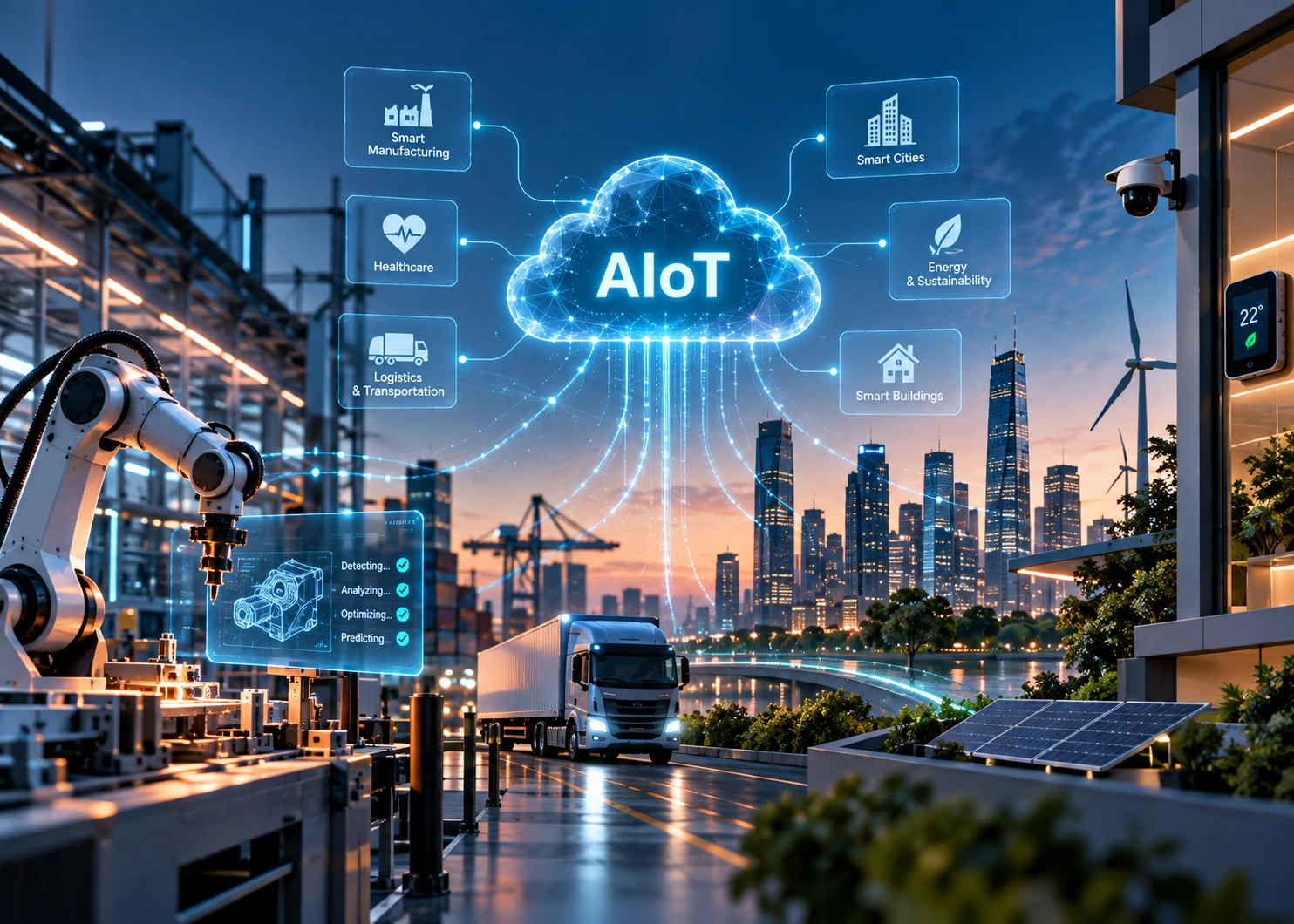
AIoT: How AI and IoT Are Creating Smarter Connected Systems
The Internet of Things (IoT) has transformed the way businesses connect devices, collect data, and monitor physical environments. But collecting data is only the beginning. The next step is making that data intelligent. AIoT, or Artificial Intelligence of Things, combines artificial intelligence with IoT to create connected systems that can analyze information, identify patterns, make…

Uncategorized
AI-Native Software Development: How AI Is Changing the Way Software Is Built
Software development is entering a new phase. Artificial intelligence is no longer being used only as a coding assistant that suggests a few lines of code. AI is increasingly becoming part of the entire software development lifecycle—from planning and architecture to coding, testing, deployment, monitoring, and maintenance. This shift is known as AI-native software development.…
Uncategorized
How to Migrate a Domain Safely Without Downtime
Your domain is more than a web address. It connects customers to your website, email, applications, landing pages, and other digital services. When you need to move your domain to a new registrar, poor planning can lead to unnecessary downtime, broken email, DNS problems, or delays. The good news is that domain migration does not…