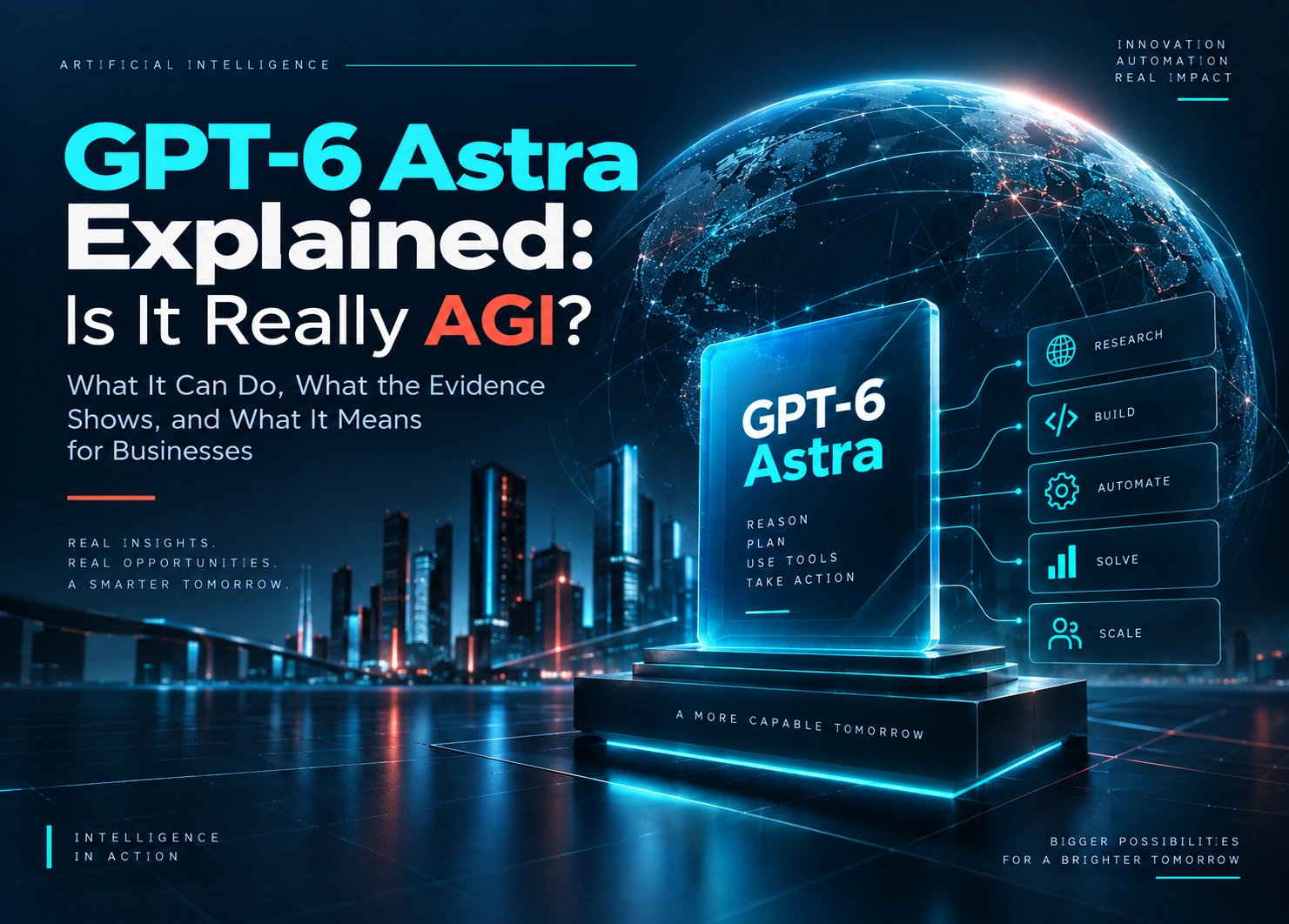
GPT-6 Astra Explained: Is It Really AGI and What Does It Mean for Businesses?
GPT-6 Astra Explained: Is It Really AGI and What Does It Mean for Businesses?
Artificial intelligence is moving from systems that answer questions to systems that can reason, use computers, make decisions, and complete multi-step tasks.
The arrival of GPT-6 Astra represents an important step in that transition. OpenAI describes Astra as its most capable model to date, with major advances in computer use, software engineering, cybersecurity, scientific reasoning, browsing, and professional work. It can research information, work with applications, create websites, test software, organize business data, and execute complex workflows with significantly greater autonomy.
But one question is dominating the AI conversation:
Is GPT-6 Astra actually AGI?
The answer depends largely on how we define Artificial General Intelligence (AGI). Astra demonstrates several capabilities associated with AGI, but benchmark results alone do not provide a universally accepted proof that AGI has arrived.
For businesses, however, another question may be even more important:
What can this new generation of AI actually do for your organization?
What Is GPT-6 Astra?
GPT-6 Astra is OpenAI’s latest frontier AI model, designed not simply to generate text but to perform complex tasks across digital environments.
Traditional AI assistants typically wait for a prompt, generate a response, and stop. Astra is designed to work through a broader sequence of actions.
For example, an AI agent can potentially:
- Research information across the web
- Work inside software applications
- Update CRM records
- Complete online forms
- Analyze datasets
- Generate documents and presentations
- Write and test software
- Build websites and applications
- Troubleshoot computer problems
- Conduct multi-step research
- Interact with digital environments
- Make decisions when instructions leave reasonable details unspecified
OpenAI reports that Astra achieved a 72.6% score on OSWorld 2.0, compared with 65.7% for GPT-5.6 Sol. In OpenAI’s latency simulation, Astra also completed these computer-use tasks in substantially less time.
This shift from answer generation to task execution is one of the most important developments surrounding Astra.
Why Is GPT-6 Astra Being Connected to AGI?
Artificial General Intelligence generally refers to AI capable of performing a broad range of intellectual tasks rather than being limited to one narrow function.
There is no single universally accepted test for AGI. Different researchers and organizations emphasize different characteristics, including reasoning, learning, adaptation, autonomy, generalization, and the ability to perform economically valuable work.
Astra demonstrates several of these characteristics.
It can operate across different domains rather than being restricted to a single application. It can reason through unfamiliar environments, use tools, adapt its approach, and complete workflows involving multiple steps.
ARC Prize’s ARC-AGI-3 benchmark is particularly relevant because it tests an AI system’s ability to explore unfamiliar environments, infer their rules, build internal models, establish goals, and plan actions.
These are capabilities closely associated with general intelligence.
However, that does not automatically mean Astra has achieved AGI.
GPT-6 Astra and the ARC-AGI-3 Benchmark
One of the most widely discussed Astra results is its performance on ARC-AGI-3.
OpenAI reports a 99.9% ARC-AGI-3 score. At first glance, that appears close to benchmark saturation.
But there is important context behind that number.
ARC Prize independently reports that Astra achieved:
- 62.7% using its Standard harness
- 99.9% using the Provider Adapter harness
Both were described by ARC Prize as state-of-the-art results, but the evaluation configurations are different.
The Provider Adapter allows Astra to preserve opaque reasoning state between requests and use context-compaction mechanisms designed for longer interactions. The Standard harness provides a more provider-neutral evaluation environment.
This distinction matters.
A benchmark score should never be interpreted without understanding how the benchmark was conducted.
ARC Prize itself makes an important point: even saturating ARC-AGI-3 would not constitute definitive proof of AGI because the benchmark is intentionally limited to a particular class of environments. Its environments are structured, deterministic, and closed-ended compared with the open-ended nature of the real world.
So the Astra result should be viewed as evidence of significant progress in agentic generalization, not as a single definitive AGI test.
What Makes Astra Different From Earlier AI Models?
The biggest change is not simply that Astra can answer harder questions.
It can do more.
Consider a conventional AI workflow.
You ask an AI:
“Analyze our website performance.”
The AI may provide recommendations.
An agentic system can potentially go much further:
- Access the relevant data.
- Analyze traffic and conversion information.
- Identify unusual patterns.
- Review relevant pages.
- Generate recommendations.
- Create a report.
- Build charts.
- Prioritize technical issues.
- Prepare implementation tasks.
That represents a fundamental change in how organizations can interact with AI.
OpenAI reports that Astra can work with browsers and computer applications, create websites, perform frontend QA, install and test software, troubleshoot problems, and produce business documents, spreadsheets, presentations, and analyses.
This is why AI agents and agentic AI automation may become more important to businesses than traditional chatbot implementations.
Is GPT-6 Astra Really AGI?
There are two different questions here.
Does Astra demonstrate capabilities associated with AGI?
Yes.
Its performance across reasoning, computer use, coding, research, professional workflows, and unfamiliar interactive environments demonstrates a much broader capability profile than traditional narrow AI systems.
Does Astra conclusively prove that AGI has been achieved?
Not based on the available benchmark evidence alone.
The answer depends on the definition of AGI being used.
A system might be considered AGI if the definition emphasizes broad autonomous cognitive work. Another definition might require robust performance across virtually all open-ended intellectual and real-world environments.
The distinction is important because AI benchmarks measure specific capabilities under specific conditions.
The real world is considerably less controlled.
Businesses have incomplete information, changing requirements, ambiguous objectives, unexpected failures, security restrictions, human stakeholders, regulations, and consequences for incorrect decisions.
Therefore, the most useful conclusion is not simply that Astra is or is not AGI.
A more accurate description is:
GPT-6 Astra represents a significant advancement toward highly autonomous, general-purpose AI systems, while the question of whether it meets a universal definition of AGI remains open.
What Does GPT-6 Astra Mean for Businesses?
This is where the development becomes particularly important.
The commercial impact of advanced AI may come less from the label “AGI” and more from the ability to automate increasingly complex workflows.
1. AI-Powered Software Development
AI systems can increasingly participate in the complete software development lifecycle.
Instead of simply generating code, an advanced AI agent can potentially analyze requirements, write code, test functionality, identify bugs, make revisions, and support deployment.
For development teams, this can reduce repetitive engineering work and allow developers to focus more heavily on architecture, product decisions, security, and innovation.
2. Intelligent Customer Support
AI agents can move beyond answering frequently asked questions.
They can potentially understand customer requests, retrieve account information, interact with business systems, perform approved actions, and escalate complicated cases to human employees.
This creates the possibility of 24/7 intelligent customer operations rather than a simple chatbot.
3. AI Sales Automation
Sales teams spend significant time researching prospects, updating CRMs, preparing follow-ups, and organizing customer information.
Agentic AI can potentially automate many of these activities.
An AI system could research a prospect, summarize relevant information, prepare personalized outreach, update CRM records, and notify a sales representative when human intervention is required.
4. Business Intelligence and Data Analysis
Businesses generate enormous quantities of data but often lack the resources to analyze all of it effectively.
AI agents can help transform raw information into actionable intelligence by analyzing datasets, identifying patterns, creating visualizations, and preparing reports.
This could make advanced analytics more accessible to smaller organizations.
5. AI-Powered QA and Operations
Astra’s ability to interact with software environments is especially relevant to quality assurance.
AI agents can potentially test interfaces, identify problems, reproduce bugs, document issues, and verify fixes.
For organizations managing complex digital products, this could significantly accelerate testing cycles.
The Biggest Challenge: Reliability
Greater autonomy creates a new challenge.
What happens when an AI makes a mistake?
An AI that produces an incorrect paragraph is one thing.
An AI that incorrectly changes a customer record, deletes data, modifies production software, sends the wrong communication, or makes an unauthorized transaction is something else entirely.
This is why agentic AI requires more than intelligence.
Businesses need:
- Permission controls
- Human approval workflows
- Monitoring
- Audit trails
- Data protection
- Role-based access
- Security testing
- Clear escalation procedures
- Reliable evaluation
- Strong integration architecture
OpenAI’s own safety documentation highlights this challenge. Astra is the company’s first model classified at the Critical level of cybersecurity capability under its Preparedness Framework. OpenAI says Astra can, with the appropriate tools and access, discover previously unknown vulnerabilities and develop exploit strategies without step-by-step human guidance.
That demonstrates both sides of advanced AI.
More capability creates more opportunity and more responsibility.
What Comes After GPT-6 Astra?
The next phase of AI is unlikely to be defined solely by bigger language models.
The focus is increasingly shifting toward AI agents that can reason, use tools, remember context, interact with software, and complete objectives.
This creates a new architecture for enterprise technology.
Instead of:
Human → Software → Result
we may increasingly see:
Human → AI Agent → Multiple Systems → Automated Workflow → Result
That does not mean humans disappear from the process.
Instead, the role of humans can move toward defining objectives, setting permissions, reviewing important decisions, managing exceptions, and providing strategic direction.
The most successful organizations will likely be those that understand where AI should operate autonomously and where human oversight remains essential.
GPT-6 Astra and the Future of AI Automation
Whether GPT-6 Astra should officially be called AGI is ultimately less important for businesses than what the technology can actually accomplish.
The significant development is the growing ability of AI systems to combine:
Reasoning + Computer Use + Tools + Memory + Autonomy + Workflow Execution
That combination can transform AI from an information assistant into an operational layer for businesses.
For companies exploring AI transformation, the opportunity is no longer limited to adding a chatbot to a website.
Organizations can begin thinking about AI agents for sales, customer support, software development, IT operations, research, analytics, marketing, and internal workflows.
At TechVaders Inc, we see this evolution as part of a broader shift toward intelligent digital ecosystems where AI systems don’t simply provide information but help businesses execute work, connect systems, and automate complex processes.
The question is no longer only “Can AI think?”
The more important business question is:
“What work can we safely and intelligently delegate to AI?”
GPT-6 Astra brings that question much closer to reality.
Frequently Asked Questions About GPT-6 Astra
What is GPT-6 Astra?
GPT-6 Astra is OpenAI’s latest frontier AI model, designed for advanced reasoning, computer use, software engineering, research, cybersecurity, browsing, and professional workflows.
Is GPT-6 Astra AGI?
GPT-6 Astra demonstrates several capabilities associated with artificial general intelligence, but whether it qualifies as AGI depends on the definition being used. Current benchmark results do not provide a universally accepted proof of AGI.
What is the ARC-AGI-3 score of GPT-6 Astra?
Astra achieved 62.7% using ARC Prize’s Standard harness and 99.9% using the Provider Adapter harness in reported ARC-AGI-3 evaluations.
What can GPT-6 Astra do?
Astra can perform advanced computer-use tasks, research information, interact with applications, write and test software, create websites, analyze data, produce business documents, and execute complex multi-step workflows.
What is agentic AI?
Agentic AI refers to AI systems capable of pursuing objectives through multiple steps, using tools, interacting with digital environments, adapting their approach, and completing tasks with greater autonomy.
Will GPT-6 Astra replace employees?
AI capability does not automatically mean complete job replacement. Its more immediate impact is likely to involve automating portions of workflows, reducing repetitive work, and changing how employees interact with software and business processes.
How can businesses prepare for agentic AI?
Businesses can start by identifying repetitive workflows, assessing where AI can create measurable value, establishing access controls and human-approval mechanisms, and integrating AI agents with existing business systems in controlled environments.
Final Thoughts
GPT-6 Astra represents an important moment in the evolution of artificial intelligence.
Its significance is not simply a higher benchmark score. It is the combination of reasoning, computer interaction, tool use, software development, research, and increasingly autonomous task execution.
Whether the industry ultimately defines Astra as AGI will depend on how AGI itself is defined and how future evaluations measure generalization in increasingly open-ended environments.
But one thing is already becoming clear:
AI is moving from answering questions to completing work.
For businesses, that transition could be far more consequential than the AGI label itself.
The organizations that begin designing secure, measurable, and human-supervised AI workflows today will be better positioned to take advantage of the next generation of intelligent automation.
The future of AI isn’t just about smarter models. It’s about building smarter systems around them.
About TechVaders Inc
TechVaders Inc is a digital technology and AI development company focused on building scalable digital ecosystems through AI development, agentic AI automation, mobile applications, software solutions, IoT, and emerging technologies.Architecting Scalable Digital Ecosystems.

Uncategorized
AIoT: How AI and IoT Are Creating Smarter Connected Systems
The Internet of Things (IoT) has transformed the way businesses connect devices, collect data, and monitor physical environments. But collecting data is only the beginning. The next step is making that data intelligent. AIoT, or Artificial Intelligence of Things, combines artificial intelligence with IoT to create connected systems that can analyze information, identify patterns, make…

Uncategorized
AI-Native Software Development: How AI Is Changing the Way Software Is Built
Software development is entering a new phase. Artificial intelligence is no longer being used only as a coding assistant that suggests a few lines of code. AI is increasingly becoming part of the entire software development lifecycle—from planning and architecture to coding, testing, deployment, monitoring, and maintenance. This shift is known as AI-native software development.…

Uncategorized
How to Migrate a Domain Safely Without Downtime
Your domain is more than a web address. It connects customers to your website, email, applications, landing pages, and other digital services. When you need to move your domain to a new registrar, poor planning can lead to unnecessary downtime, broken email, DNS problems, or delays. The good news is that domain migration does not…
Delivering scalable software that drives real business growth.