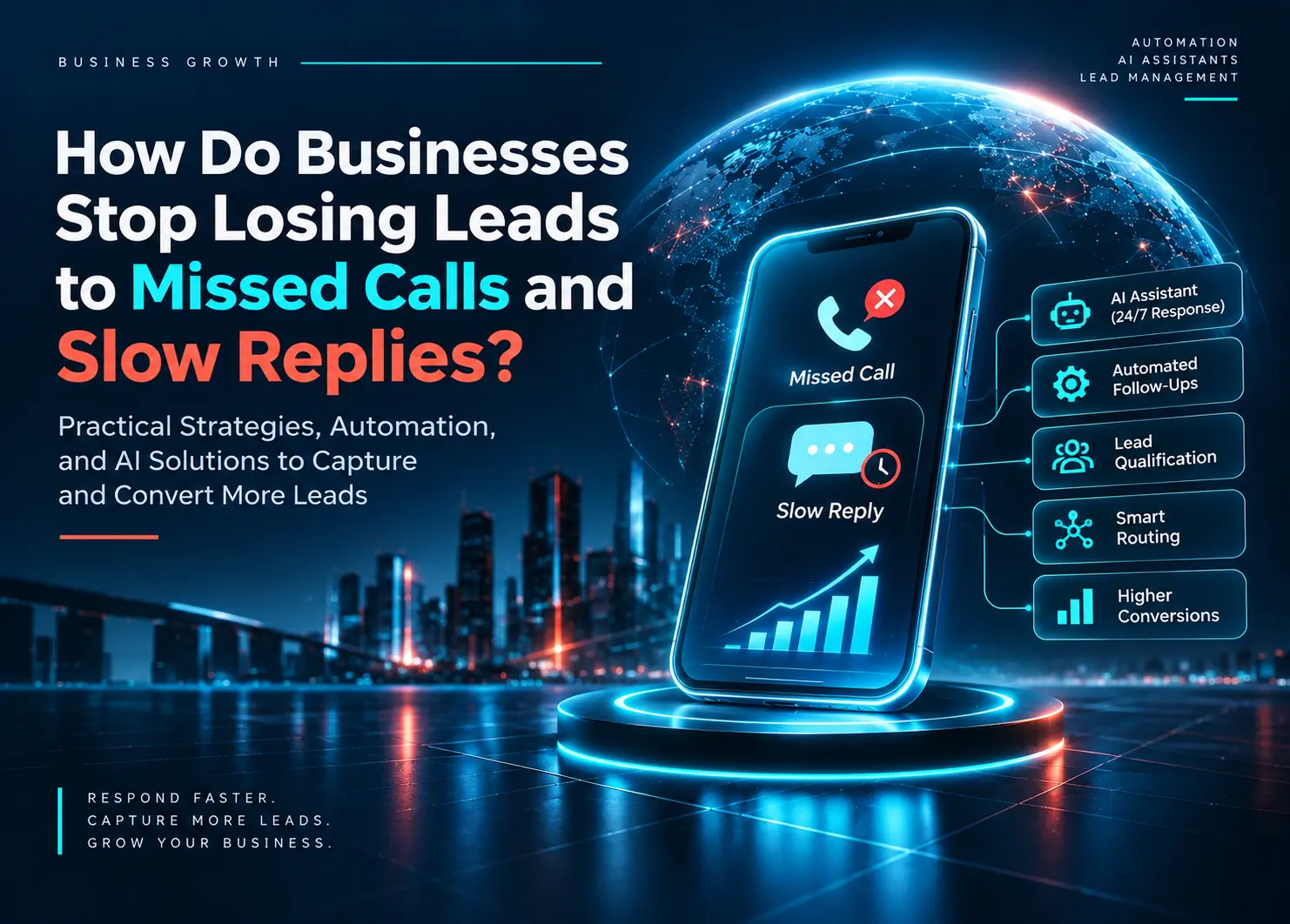

How Do Businesses Stop Losing Leads to Missed Calls and Slow Replies?
How Do Businesses Stop Losing Leads to Missed Calls and Slow Replies?
Businesses often spend considerable time and money attracting potential customers through advertising, websites, social media, and referrals. However, generating a lead is only the first step. If a potential customer calls and nobody answers, or sends a message and receives a reply hours later, that opportunity may quickly turn into a lost sale.
In today’s competitive market, customers expect businesses to respond quickly, provide helpful information, and make it easy to take the next step. A delayed response can cause prospects to contact a competitor who is more readily available.
The solution isn’t necessarily hiring more staff. Businesses can improve lead management by combining better communication processes, automation, and intelligent technology.
Why Missed Calls and Slow Replies Cost Businesses Customers
A missed call may seem like a small operational issue, especially when employees are busy serving existing customers, attending meetings, or handling daily responsibilities. But every unanswered inquiry represents a potential opportunity that may not return.
According to Invoca’s 2026 call benchmark research, only around 56% of calls to businesses were answered by a person across the measured industries. That means a significant share of callers may not immediately reach someone who can help them.
The problem extends beyond phone calls. Website inquiries, emails, social media messages, and online booking requests can also be overlooked when businesses rely entirely on manual follow-up.
Common reasons include:
- Employees handling multiple responsibilities
- Calls arriving outside business hours
- High volumes of inquiries during busy periods
- Leads being assigned without clear ownership
- Delayed email or message notifications
- No structured follow-up process
- Customer information spread across multiple platforms
Without a reliable system, businesses may lose leads simply because they couldn’t respond at the right time.
1. Respond to Leads as Quickly as Possible
Speed matters when someone expresses interest in a product or service. A person requesting a quote, booking an appointment, or asking about pricing is often actively evaluating their options.
Research published by Harvard Business Review found that companies contacting online leads within an hour were substantially more likely to qualify those leads than companies waiting longer. The study also highlighted the importance of responding quickly rather than allowing inquiries to remain unattended.
Businesses can improve response times by:
- Sending an immediate acknowledgment after receiving an inquiry
- Automatically notifying the appropriate sales representative
- Prioritizing high-intent leads
- Establishing response-time expectations
- Tracking how long each inquiry remains unanswered
An automated acknowledgment doesn’t need to replace a human conversation. Its purpose is to reassure the customer that their inquiry has been received and that someone will follow up.
2. Make Sure Every Missed Call Receives Follow-Up
Missed calls should never disappear into call logs without action.
Businesses can establish a structured missed-call process that automatically:
- Records the missed call.
- Identifies the caller, when possible.
- Sends a confirmation message.
- Creates a follow-up task.
- Notifies the responsible employee.
- Tracks whether the customer has been contacted.
For example, a customer calling a service company could receive a message:
Thank you for contacting us. We’re currently assisting other customers, but we’ve received your call. Please let us know how we can help, and our team will get back to you shortly.
This simple process creates a better experience and reduces the chance that potential customers will assume the business is unavailable.
3. Use AI to Handle Initial Customer Inquiries
Artificial intelligence can help businesses respond to customers when employees are unavailable. AI-powered assistants can operate across websites, messaging platforms, and phone systems to provide immediate responses and collect relevant information.
Depending on how they are configured, AI assistants can:
- Answer frequently asked questions
- Collect customer names and contact information
- Understand the reason for an inquiry
- Qualify potential leads
- Provide basic information about products or services
- Schedule appointments
- Route inquiries to the appropriate department
- Initiate follow-up workflows
For example, a potential customer contacting a real estate business after office hours could interact with an AI assistant that asks about their preferred location, budget, and property requirements. The system can record these details and notify a sales representative, allowing the team to follow up with a more informed conversation.
This is where Agentic AI Automation can help businesses move beyond simple automated replies. Intelligent AI agents can connect with business tools, process information, and execute multi-step workflows based on defined objectives.
4. Automate Lead Qualification and Routing
Not every inquiry requires the same response. Some customers may be ready to purchase, while others are simply researching their options.
Businesses can use automation to categorize incoming leads based on factors such as:
- Product or service requirements
- Budget
- Urgency
- Location
- Customer type
- Requested appointment date
- Specific questions or needs
Once the inquiry has been categorized, it can automatically be routed to the appropriate employee or department.
For example:
| Customer Inquiry | Automated Action |
| Requests pricing | Send pricing information or notify sales |
| Wants a consultation | Offer available appointment slots |
| Needs technical assistance | Route to support |
| Requests a callback | Create a callback task |
| High-value prospect | Notify senior sales representative |
| General question | Provide an automated response |
This reduces unnecessary delays and helps employees focus on inquiries that require human expertise.
Businesses looking to implement these capabilities can explore AI Development Solutions to understand how intelligent systems can be integrated into existing business operations.
5. Create a Consistent Follow-Up System
A single response may not be enough to convert every potential customer. Some prospects need additional information, time to make a decision, or a reminder to continue the conversation.
A structured follow-up system can help businesses maintain communication without relying on employees to remember every interaction.
A simple follow-up workflow might look like this:
Automated Lead Follow-Up Workflow
- Inquiry received: A lead contacts the business.
- Immediate acknowledgment: The customer receives confirmation.
- Lead assigned: The inquiry is routed to the appropriate team member.
- First follow-up: A representative contacts the prospect.
- Reminder generated: If no response or action occurs, the system creates a follow-up reminder.
- Lead status updated: The system tracks the inquiry as contacted, qualified, converted, or inactive.
Automation can make this process more consistent while allowing employees to personalize conversations when necessary.
6. Connect Communication Channels
Businesses often receive inquiries through multiple channels:
- Phone calls
- Website contact forms
- Social media
- Live chat
- Online booking systems
When these channels operate independently, employees may struggle to maintain a complete picture of customer interactions.
Integrating communication channels into a centralized system helps businesses track inquiries, review previous conversations, assign responsibilities, and maintain continuity.
For example, if a customer first contacts a business through a website form and later calls, the team should ideally be able to access the original inquiry and understand what the customer needs.
Connected systems reduce repeated questions, improve customer experience, and make follow-up easier.
7. Measure Lead Response Performance
Businesses cannot improve what they don’t measure.
Tracking a few important metrics can reveal where leads are being lost and whether new processes are improving performance.
| Metric | What It Measures |
| Missed call rate | Percentage of incoming calls not answered |
| Response time | Time taken to respond to a new inquiry |
| Callback rate | Percentage of missed calls that receive follow-up |
| Lead contact rate | Percentage of leads successfully contacted |
| Lead qualification rate | Percentage of inquiries that become qualified prospects |
| Conversion rate | Percentage of leads that become customers |
| Follow-up completion | Percentage of leads receiving planned follow-ups |
Reviewing these metrics regularly can help identify operational problems, such as missed calls during certain hours, slow responses from specific departments, or inquiries that never receive a second follow-up.
8. Keep Human Support Available
Automation can improve response times, but customers should still have access to human assistance when they need it.
AI is particularly useful for handling routine questions, collecting information, and organizing workflows. More complex situations—such as complaints, negotiations, technical problems, or unusual customer requests—may require a human employee.
The most effective approach is to combine automation with human expertise.
AI can handle the initial interaction, gather relevant details, and direct the customer toward the right next step. Employees can then focus on building relationships, solving problems, and closing sales.
This approach allows businesses to provide faster service without making customer interactions feel impersonal.
How AI Automation Helps Businesses Capture More Opportunities
As businesses grow, managing every inquiry manually becomes increasingly difficult. More customers, more communication channels, and more complex workflows can create gaps in the sales process.
AI-powered automation can help address these challenges by connecting communication systems, customer data, and business workflows.
With the right implementation, businesses can create systems that:
- Respond to inquiries around the clock
- Reduce the number of unanswered calls
- Automatically capture and organize lead information
- Qualify prospects based on predefined criteria
- Schedule appointments and callbacks
- Notify employees about important opportunities
- Maintain consistent follow-up
- Provide insights into lead management performance
The goal isn’t to automate every customer interaction. It’s to make sure every opportunity receives timely attention and reaches the right person.
Businesses exploring intelligent workflow solutions can learn more about Agentic AI Automation Services and how AI agents can help automate complex, multi-step business processes.
Conclusion
Missed calls and slow replies don’t always mean businesses lack customers or marketing opportunities. Often, the problem is that existing inquiries aren’t being handled efficiently.
By improving response times, implementing structured follow-up processes, connecting communication channels, and using intelligent automation, businesses can reduce the number of leads that slip through the cracks.
A timely response can make the difference between a prospect choosing your business or moving on to a competitor.
The businesses that succeed aren’t necessarily those that receive the most inquiries. They’re the ones that consistently turn those inquiries into meaningful conversations and customer relationships.
Ready to make your business communication smarter and more efficient? Explore how TechVaders’ AI Development and Automation solutions can help build intelligent systems that support your business growth.

Uncategorized
AIoT: How AI and IoT Are Creating Smarter Connected Systems
The Internet of Things (IoT) has transformed the way businesses connect devices, collect data, and monitor physical environments. But collecting data is only the beginning. The next step is making that data intelligent. AIoT, or Artificial Intelligence of Things, combines artificial intelligence with IoT to create connected systems that can analyze information, identify patterns, make…

Uncategorized
AI-Native Software Development: How AI Is Changing the Way Software Is Built
Software development is entering a new phase. Artificial intelligence is no longer being used only as a coding assistant that suggests a few lines of code. AI is increasingly becoming part of the entire software development lifecycle—from planning and architecture to coding, testing, deployment, monitoring, and maintenance. This shift is known as AI-native software development.…

Uncategorized
How to Migrate a Domain Safely Without Downtime
Your domain is more than a web address. It connects customers to your website, email, applications, landing pages, and other digital services. When you need to move your domain to a new registrar, poor planning can lead to unnecessary downtime, broken email, DNS problems, or delays. The good news is that domain migration does not…